%20(1)_edited_edited.png)


New Harriet Tubman Scenic Byway Brings Tourism Opportunities and New Limits for Billboard Companies

By CNYOnline.com Local News
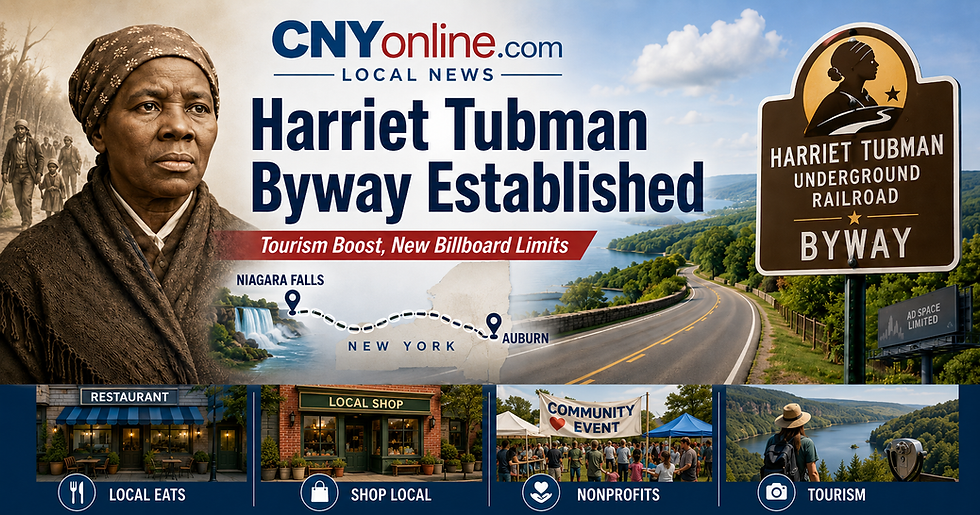
New York State has officially established the Harriet Tubman Underground Railroad Scenic Byway, creating a nearly 177-mile route connecting historic sites from Auburn to Niagara Falls.
Governor Kathy Hochul signed the legislation on June 13, 2026, formally adding the route to New York’s Scenic Byways System.
The first phase passes through eight counties and links 22 locations associated with Harriet Tubman, freedom seekers and the Underground Railroad.
The route begins in Auburn and travels through portions of Cayuga, Seneca, Ontario, Wayne, Monroe, Orleans, Erie and Niagara counties before reaching Niagara Falls. The New York State Department of Transportation is expected to install signs directing motorists toward historical landmarks and communities along the corridor.
State officials believe the byway could strengthen heritage tourism by encouraging visitors to stop at historical attractions, restaurants, shops, lodging establishments and other locally owned businesses. The governor’s office said the route will also connect travelers with African American neighborhoods, recreational resources and businesses located throughout Central and Western New York.
What the Designation Means for Billboard Companies
While the scenic byway could generate new tourism and economic activity, it also creates concerns for outdoor advertising companies ranging from large regional operators to small, locally owned billboard businesses.
Federal regulations prohibit the construction of most new off-premise advertising signs along designated scenic byways that are part of the Interstate, National Highway System or former Federal-aid primary highway system. New York’s Scenic Byways Program requires participating communities to acknowledge that prohibition as part of the corridor-management process.
An off-premise sign generally advertises a business, organization, service or product that is not located on the same property as the sign. These signs include many traditional and digital billboards used by businesses to reach motorists away from their physical locations.
The restriction does not mean every billboard along the entire route must be removed. Lawfully established signs may remain subject to their existing permits, applicable grandfathering protections, and continuing compliance with state and local regulations.
Businesses may also continue using qualifying on-premise signs located on the same property where the advertised activity takes place. New York State defines on-premise signs as signs located on property that is integral to the business or activity being advertised.
However, the scenic byway designation could significantly reduce opportunities for billboard companies to construct new off-premise advertising displays along affected sections of the corridor.
Smaller Billboard Companies Could Feel a Greater Impact
Large outdoor advertising companies frequently operate hundreds or thousands of displays across multiple regions. A restriction affecting one corridor may represent only a small portion of their overall inventory.
For small local billboard companies, however, a limited number of locations may represent a substantial percentage of the company’s revenue and available advertising space.
Small operators often serve local customers that cannot afford large television, radio, or statewide advertising campaigns that sometimes bring much smaller returns on the advertising budget.
Their clients may include:
Local restaurants and coffee shops
Contractors and home-service companies
Retail stores and family-owned shops
Farms, markets and seasonal attractions
Nonprofit organizations
Volunteer fire departments
Food pantries and charitable organizations
Community festivals and fundraisers
Local tourism destinations
Small professional-service businesses
Digital billboards can rotate multiple advertisers through the same display, allowing businesses and nonprofit organizations to share the cost of reaching thousands of motorists. This can make outdoor advertising more affordable than purchasing a traditional static billboard for an extended period.
Restrictions on new billboard construction could therefore affect more than the billboard industry itself. They may also limit future advertising options for local organizations that depend on affordable, highly visible community promotion.
Digital Billboards Serve More Than Commercial Advertisers
Modern digital billboards are frequently used for purposes beyond commercial advertising.
Depending on the operator and location, billboard companies may provide space for emergency notifications, missing-person alerts, public-safety messages, weather warnings, road closures and community announcements.
They can also promote county fairs, farmers markets, concerts, school events, nonprofit fundraisers, food drives, local festivals and tourism attractions.
During emergencies, digital displays can update messages quickly without requiring crews to physically replace printed materials. This ability can make them a valuable communication tool for communities, law-enforcement agencies and emergency-service organizations.
Local billboard companies also regularly donate or discount advertising space for charitable causes and community events that could not otherwise afford widespread promotion.
Balancing Historic Preservation and Local Commerce
The Harriet Tubman Underground Railroad Scenic Byway represents an important effort to preserve and promote New York’s history while honoring Tubman, abolitionists and the freedom seekers who traveled through the state.
Supporters believe the designation will attract visitors, increase spending and create new opportunities for businesses located along the route. State lawmakers said the byway could potentially draw hundreds of thousands of visitors and possibly more than one million into communities connected to Underground Railroad history.
At the same time, the restrictions connected with scenic byway status raise legitimate economic questions for outdoor advertising companies and the customers they serve.
A balanced approach will require state and local officials to protect the historical character of the corridor while recognizing the important role that billboards—particularly digital billboards—play in helping local businesses, nonprofits and community organizations communicate affordably with the public.
Existing billboard operators will need to carefully review their permits, property rights, municipal regulations and the specific highway segments covered by the new designation. Communities should also consider how official tourism signs, on-premise advertising, visitor-directional signage and existing legal billboards can work together to guide travelers toward local attractions and businesses.
The new byway has the potential to become both a powerful historical resource and an economic driver. Ensuring that local businesses have practical, affordable ways to reach those new visitors will be an important part of turning that potential into lasting benefits for communities across New York.